

Filing a water damage insurance claim requires stopping the source of water intrusion, documenting the damage, and submitting the required information to the insurer within the policy's filing deadline. The claims process moves through distinct stages, from the initial decision to file through adjuster review, repair, and final payout, and understanding each stage helps a policyholder avoid the common mistakes that lead to reduced payouts or denied claims.
How to File a Successful Water Damage Insurance Claim?
Filing a successful water damage insurance claim follows five sequential steps: documenting the damage, contacting the insurer, meeting the adjuster, obtaining repair estimates, and completing repairs with final documentation.
Document the Damage
Document the damage immediately after discovering water intrusion and before beginning any cleanup. Photograph and video every affected area, including standing water, damaged materials, and affected belongings, from multiple angles. Create an itemized inventory of damaged personal property, noting the approximate age and value of each item, since this inventory supports the claimed amount during adjuster review.
Contact Your Insurance Company
Contact the insurance company as soon as possible after documenting the damage to open the claim and receive a claim number. Most insurers offer claim reporting by phone, online portal, or mobile app, and the initial report typically requires a description of the cause, the date of loss, and the affected areas. The insurer assigns a claims adjuster following this initial report, and the claim number becomes the reference point for all further communication.
Meet With the Claims Adjuster
Meet with the claims adjuster to allow an in-person or virtual inspection of the damage before repairs begin. The adjuster assesses the extent of the damage, reviews the policyholder's documentation, and determines whether the cause of loss falls within the policy's covered perils. Providing the adjuster with the photographs, video, and inventory gathered earlier supports an accurate assessment and reduces the likelihood of disputes over the claim's scope.
Get Repair Estimates
Get repair estimates from a licensed water damage restoration company to establish the actual cost of returning the property to its pre-loss condition. A detailed estimate itemizes extraction, drying, sanitization, and repair costs by affected area, giving the adjuster a documented basis for approving the claim at its full value. Comparing a contractor's estimate against the adjuster's initial assessment identifies any gaps that require further negotiation before repairs proceed.
Complete Repairs and Submit Final Documentation
Complete repairs using the approved contractor and submit final documentation, including paid invoices and receipts, to close out the claim. The insurer reconciles the final repair cost against the initial payout, issuing any remaining balance owed under the policy's coverage terms. Retaining copies of all documentation, including the adjuster's report and final invoices, protects the policyholder if a dispute arises after the claim closes.
Should You File a Water Damage Insurance Claim?

Filing a water damage insurance claim makes sense when the repair cost exceeds the policy deductible, and the cause of damage qualifies as a covered peril under the policy terms.
When Does Filing a Water Damage Claim Make Sense?
Filing a water damage claim makes sense when the estimated repair cost significantly exceeds the policy deductible and the damage resulted from a sudden and accidental cause, such as a burst pipe or appliance failure.
Extensive structural damage affecting multiple rooms, flooring, or ceiling materials typically justifies filing, since the repair cost in these cases substantially exceeds what most policyholders would cover independently.
A claim involving Category 2 or Category 3 contaminated water also generally warrants filing, since remediation costs for contaminated water losses tend to be higher than clean water losses.
When You Might Skip Filing (Small Claims and Premium Impact)
Skipping a claim makes sense when the repair cost falls near or below the policy deductible, since filing in this situation provides little or no financial benefit. Multiple claims filed within a short period can increase future premiums or affect renewal eligibility, so policyholders often weigh this longer-term cost against the immediate repair expense before filing for moderate damage.
Paying out of pocket for a minor, contained leak, such as a small appliance leak affecting a single area, frequently costs less over time than the resulting premium increase from filing a claim.
What to Do Before You File a Water Damage Insurance Claim?
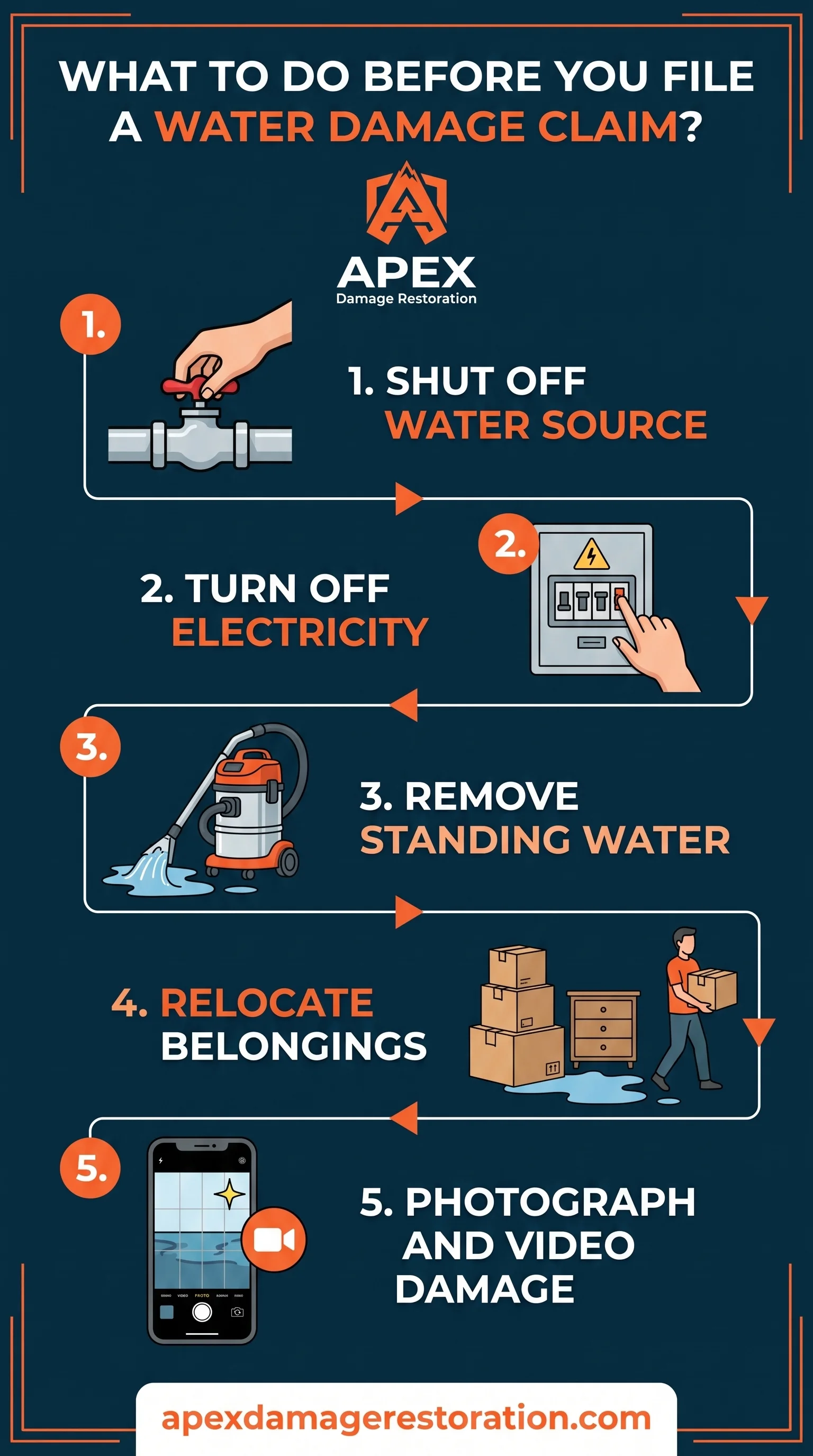
Before filing a water damage insurance claim, stop the water source, prevent further damage, and document the loss. Completing these steps protects the property and preserves the evidence the insurer needs to process the claim accurately.
- Shut off the water source: Turn off the main water supply valve or the specific fixture involved to stop continued water flow into the structure.
- Turn off electricity if needed: Cut power to affected circuits at the breaker panel when water contacts outlets, switches, or wiring.
- Remove standing water: Extract or mop up standing water to limit absorption into flooring, subflooring, and walls.
- Relocate unaffected belongings: Move furniture and belongings away from the damaged area to prevent secondary damage.
- Photograph and video the damage: Capture every affected area before beginning cleanup or discarding any items.
What Happens After You File a Water Damage Insurance Claim?
After filing a water damage insurance claim, an insurer assigns a claims adjuster, inspects the damage, issues a coverage decision, and pays out according to the policy terms. The adjuster typically contacts the policyholder within a few business days to schedule an inspection, then reviews the submitted documentation and inspects the property in person or virtually.
Based on this review, the insurer issues a coverage determination and an initial payout estimate. Many insurers release an initial payment before repairs are complete, followed by a final payment once the policyholder submits paid invoices and any additional requested documentation.
Most straightforward claims reach a coverage determination within two to four weeks of the initial adjuster inspection.
What Are The Common Mistakes That Get Water Damage Claims Denied?
Water damage claims are commonly denied due to documentation gaps, reporting delays, and disputes over the cause of the damage.
- Skipping photos before cleanup: Removing damaged materials before documenting them eliminates the evidence an adjuster needs to verify the loss.
- Delaying the report: Reporting damage weeks after discovery raises questions about whether the policyholder acted to prevent further loss.
- Gradual damage classification: Insurers deny claims involving prolonged, undetected leaks by classifying them as gradual water damage rather than sudden.
- Incomplete inventory: Submitting a claim without an itemized list of damaged belongings weakens the claimed value.
- No professional assessment: Filing the claim without a restoration company's documented scope of work provides less supporting evidence than a detailed, itemized estimate.
Get Professional Help With Your Water Damage Claim and Restoration
Apex Damage Restoration provides emergency water damage restoration services that include extraction, structural drying, and detailed damage documentation that supports every stage of the insurance claims process. Our technicians assess the affected areas, prepare an itemized scope of work, and coordinate directly with adjusters to help policyholders receive an accurate claim payout. Contact Apex Damage Restoration for a water damage assessment before filing your insurance claim.
Need Emergency Restoration Help Today?
Call Apex Damage Restoration now for fast priority dispatch across Aurora, CO, a written estimate before work begins, and direct insurance claims assistance.