
Water damage is classified into four classes, Class 1 through Class 4, based on the amount of water absorbed into a structure and the rate at which the affected materials will dry. The Institute of Inspection, Cleaning and Restoration Certification (IICRC) defines this classification system in the S500 Standard for Professional Water Damage Restoration. Restoration professionals use the class to determine drying equipment, technique, and expected timeline, separate from the water's contamination level.
What Water Damage Class Means (IICRC Standard)
Water damage class refers to the classification system in the IICRC S500 Standard that measures how much water a structure has absorbed and how quickly that moisture will evaporate during drying. The S500 Standard establishes class based on two factors: the extent of material saturation and the anticipated evaporation load, which is the amount of moisture the drying equipment must remove from the air.
Water damage class differs from water damage category, which measures contamination level rather than moisture volume. A structure can carry a high water damage class with a low contamination category, or the reverse, since the two systems evaluate separate variables. Restoration technicians assign class after assessing which materials absorbed water and how much of the structure sustained saturation.
The Four Classes of Water Damage
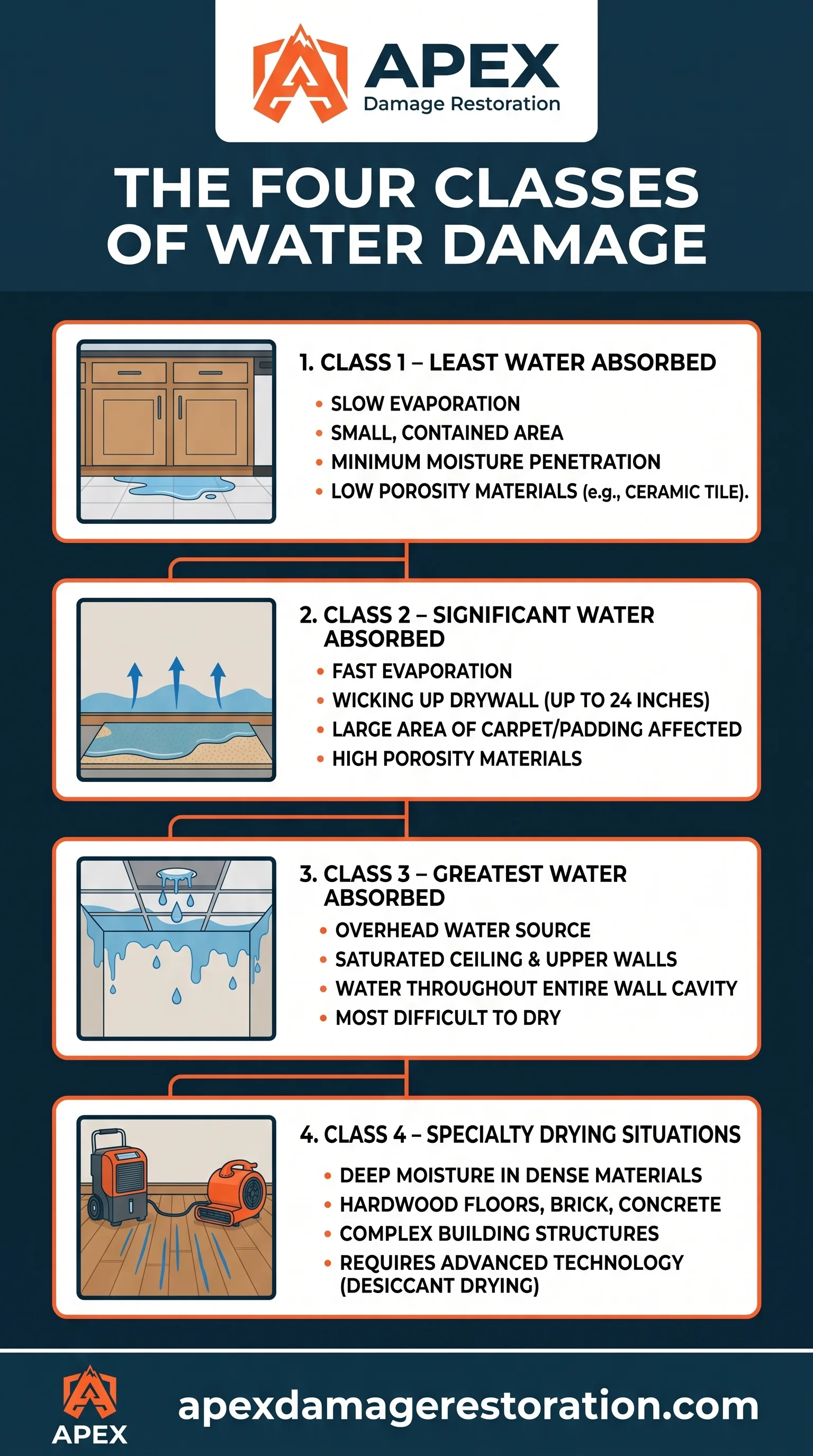
The IICRC S500 Standard defines four classes of water damage, numbered 1 through 4 in order of increasing absorption and evaporation load. Each class describes a distinct combination of affected materials, room coverage, and drying difficulty.
Class 1 – Least Water Absorbed
Class 1 water damage involves the least amount of water absorption and affects only part of a room or area. Low-porosity materials such as concrete, plywood, and structural wood absorb minimal moisture in a Class 1 loss, and carpet or cushion saturation is typically absent. The evaporation load is low because a limited surface area holds moisture, which allows standard air movers and dehumidifiers to complete drying within a shorter timeframe than higher classes require. A Class 1 loss commonly results from a slow leak or brief water exposure with minimal spread, such as a small appliance supply line leak confined to one cabinet area.
Class 2 – Significant Water Absorbed (Fast Evaporation)
Class 2 water damage involves significant water absorption into carpet, cushion, and wall materials, with moisture wicking upward and affecting an entire room. Water in a Class 2 loss moves beyond the point of contact, saturating carpet padding and rising several inches up drywall through capillary action.
The evaporation rate in Class 2 losses is faster than Class 1 because more wetted surface area releases moisture into the air simultaneously, which increases the equipment capacity needed to manage humidity. A burst pipe that floods a full room commonly produces Class 2 conditions when water contacts carpet and lower wall sections throughout the space.
Class 3 – Greatest Water Absorbed (Fastest Evaporation)
Class 3 water damage involves the greatest water absorption and results from water entering a structure from overhead, saturating ceilings, walls, insulation, and subfloor materials. Water source location distinguishes Class 3 from Class 2: Class 3 losses originate above the affected space, such as a failed roof or broken supply line on an upper floor, allowing water to soak insulation and structural cavities before reaching the floor.
The evaporation rate in Class 3 losses is the fastest among the four classes because the greatest surface area, including saturated ceiling materials, releases moisture into the air at once, requiring the highest equipment capacity to manage the drying environment.
Class 4 – Specialty Drying Situations
Class 4 water damage involves deep saturation of low-porosity materials that release moisture slowly, requiring specialty drying methods beyond standard equipment. Hardwood flooring, plaster, brick, and stone absorb water into their dense structure in a Class 4 loss, and this moisture migrates deep into the material rather than remaining near the surface. Standard air movers and dehumidifiers cannot extract moisture from these materials at a practical rate, so restoration technicians apply desiccant dehumidification or injection drying systems that target trapped moisture directly. Class 4 losses require longer drying times than the other three classes because of this slow release rate, regardless of the total water volume involved.
How Restoration Professionals Determine Water Damage Class?
Restoration professionals determine water damage class through moisture meter readings, thermal imaging, and direct visual and tactile inspection of affected materials. An IICRC-certified technician measures moisture content in walls, flooring, and other building materials using a moisture meter, comparing readings against dry standard values established for unaffected areas of the same structure. Thermal imaging cameras identify temperature variations that indicate moisture behind surfaces not visible during a standard inspection, such as within wall cavities or under flooring.
The technician combines these instrument readings with a physical inspection of the water source, affected material types, and the extent of saturation across the space. This assessment determines which of the four classes applies and, in turn, which drying equipment and technique the restoration plan requires.
What's the Difference Between Water Damage Class vs. Water Damage Category?
Water damage class and water damage category measure two different aspects of the same loss: class measures moisture volume and evaporation load, while category measures contamination level. The IICRC S500 Standard separates these into distinct classification systems because a structure's drying requirements and its health and safety requirements depend on different variables.
Water damage category divides contamination into three levels: Category 1 (clean water from a sanitary source), Category 2 (gray water containing some contaminants), and Category 3 (black water containing sewage or other hazardous material). A Class 3 loss can occur with Category 1 water, such as a burst supply line soaking a ceiling, or with Category 3 water, such as sewage backup reaching the same materials. Restoration technicians evaluate class and category independently because equipment selection depends on class, while personal protective equipment and material disposal decisions depend on category.
Why Water Damage Class Matters for Restoration and Insurance?
Water damage class matters because it determines drying time, equipment cost, and the documentation insurers require to process a claim. A Class 4 loss requires specialty equipment such as desiccant dehumidifiers, which carries a higher rental and labor cost than the standard air movers sufficient for a Class 1 loss, and extends the drying timeline from days to potentially weeks depending on material saturation depth.
Insurance adjusters use the assigned water damage class to verify that the equipment and labor billed on a restoration invoice match the scope of the loss. A restoration company's documentation, including moisture meter readings, class determination, and the equipment deployed, supports the claim by showing that the drying approach corresponds to the category and severity of water damage recorded at the time of loss. Underestimating class during the initial assessment can result in incomplete drying, which risks secondary damage such as mold growth and may not be covered under a standard restoration claim.
Need Emergency Restoration Help Today?
Call Apex Damage Restoration now for fast priority dispatch across Aurora, CO, a written estimate before work begins, and direct insurance claims assistance.