
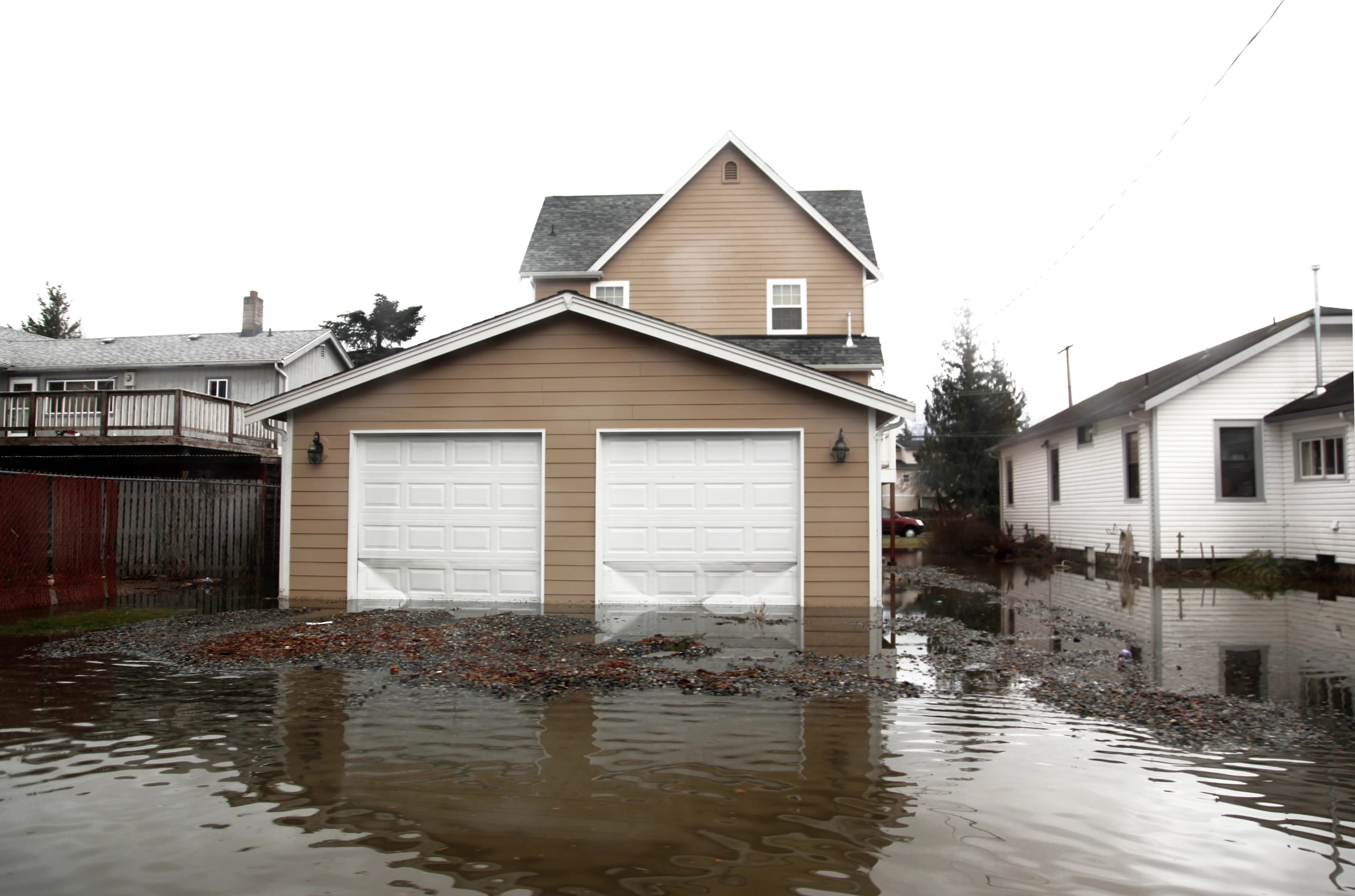
Water damage restoration costs range from $1,300 to $5,700 for an average job, with most homeowners paying around $3,300. Total cost depends on the service type, water category, affected square footage, and how quickly a restoration company responds after the damage occurs.
Minor water damage confined to a single room can cost as little as $150 to repair, while a severe flood affecting multiple rooms or requiring structural rebuild can exceed $10,000. Restoration companies typically price mitigation work (extraction and drying) by the square foot and price repair or rebuild work by the scope of materials replaced.
What Is the Average Cost of Water Damage Restoration?
The national average cost for water damage restoration is $3,300, with a typical range of $1,300 to $5,700 depending on severity and scope. A small, contained leak costs closer to the low end of this range, while a whole-floor flood pushes costs toward the high end or beyond.
Restoration companies calculate final cost from three combined factors: the size of the affected area, the water category, and whether the job requires mitigation only or mitigation plus rebuild. A single burst pipe that floods one bathroom and is addressed within 24 hours costs far less than the same pipe left unaddressed for several days, because standing water spreads contamination and increases the area requiring drywall and flooring replacement.
2026 Cost at a Glance
| Damage Scope | Typical Cost Range |
|---|---|
| Minor leak, single room, mitigation only | $150 – $1,000 |
| Moderate leak, one to two rooms | $1,000 – $3,500 |
| Significant flood, multiple rooms | $3,500 – $7,500 |
| Severe flood with structural rebuild | $7,500 – $25,000+ |
How Much Does Water Damage Restoration Cost by Service Type?
Water damage restoration cost splits into two distinct service categories: mitigation and repair/rebuild, each priced under a different structure. Mitigation removes standing water and dries the structure to stop further damage; repair and rebuild replace materials that mitigation could not save.
Restoration companies usually bill mitigation by square footage and bill repair/rebuild by material and labor for each item replaced. A job can require mitigation alone, repair alone, or both in sequence, and combining the two typically costs less than hiring separate contractors for each phase.
Mitigation vs. Repair/Rebuild Cost
| Service Type | Pricing Basis | Typical Cost |
|---|---|---|
| Mitigation (extraction and drying) | Per square foot | $3.75 – $7.00 per sq ft |
| Repair and rebuild | Per item/material | $2 – $20+ per sq ft depending on material |
How Much Does Water Extraction and Drying Cost?
Water extraction and drying costs $3.75 to $7.00 per square foot, covering equipment, labor, and monitoring until the structure reaches a safe moisture level. This price includes standing-water removal, placement of air movers and dehumidifiers, and daily moisture readings to confirm the space has dried.
Drying time affects total mitigation cost because equipment rental is billed per day. A single room typically dries within three to five days under standard airflow, while a larger or more saturated area can require seven days or more, adding to the equipment portion of the bill.
How Much Does Repair and Rebuild Cost?
Repair and rebuild after water damage costs $2 to $20 or more per square foot, depending on the materials replaced and the extent of demolition required. Drywall replacement falls at the lower end of this range, while hardwood flooring, cabinetry, and trim replacement push costs toward the higher end.
Repair scope depends directly on how much material the water contaminated beyond recovery. A contractor removes and replaces only the affected drywall, insulation, or flooring identified during the flood-cut process, rather than the entire room, unless contamination or structural damage requires a full rebuild.
How Does Water Category Affect Restoration Cost?
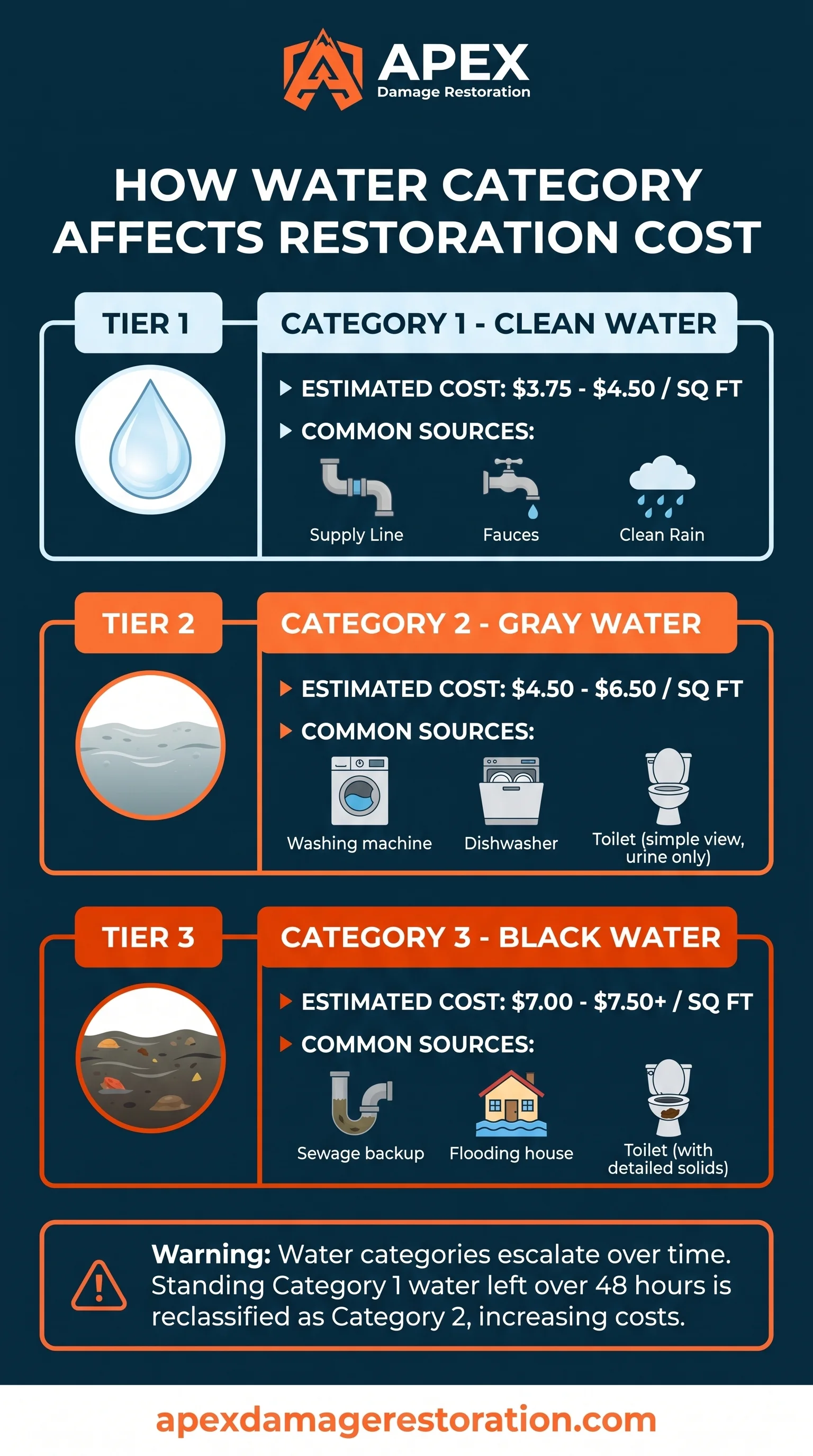
Water category affects restoration cost because contaminated water requires additional decontamination, protective equipment, and disposal steps beyond standard extraction and drying. The Institute of Inspection, Cleaning and Restoration Certification (IICRC) classifies water damage into three categories, and each category carries a different price per square foot.
Category 1 water originates from a clean source, such as a supply line, and costs the least to remediate. Category 2 water (gray water) contains contaminants from sources like a washing machine or dishwasher discharge and requires additional sanitizing. Category 3 water (black water) contains sewage or floodwater and requires full decontamination, protective equipment, and disposal of porous materials that contact it.
Cost by Water Category
| Category | Source Example | Typical Cost per Sq Ft |
|---|---|---|
| Category 1 (clean) | Supply line, faucet, rainwater | $3.75 – $4.50 |
| Category 2 (gray) | Washing machine, dishwasher, toilet overflow (urine only) | $4.50 – $6.50 |
| Category 3 (black) | Sewage backup, flooding, toilet overflow with solids | $7.00 – $7.50+ |
Water category can escalate over time. Category 1 water left standing for more than 48 hours begins to support bacterial growth and may be reclassified as Category 2, which increases the remediation cost even though the source was clean.
How Much Does Emergency Water Extraction Cost?
Emergency water extraction costs $500 to $2,500 for standard after-hours dispatch, covering truck-mounted extraction equipment, technician labor, and immediate placement of drying equipment. Restoration companies charge an emergency or after-hours dispatch premium on top of standard extraction rates when a homeowner requires response outside regular business hours.
The after-hours premium typically adds 25% to 50% to the base extraction cost. This premium covers technician overtime rates and priority equipment deployment, since active flooding requires extraction within hours to limit the area requiring later repair.
Emergency Extraction Line Items
| Line Item | Typical Cost |
|---|---|
| Truck-mounted water extraction | $200 – $600 per visit |
| Air movers (per unit, per day) | $30 – $80 |
| Dehumidifiers (per unit, per day) | $50 – $150 |
| After-hours dispatch premium | 25% – 50% above standard rate |
Drying-day count directly affects total emergency extraction cost, since air movers and dehumidifiers remain billed daily until moisture readings confirm the structure has dried. A standard job requires three to five drying days; a job involving structural cavities or subfloor saturation can extend to seven days or longer.
How Much Does a Water Damage Inspection or Estimate Cost?
A water damage inspection typically costs $150 to $400 when billed as a standalone service, though many restoration companies waive this fee when the homeowner hires them for the resulting repair work. The inspection covers moisture mapping with a meter or thermal camera to identify the full extent of water intrusion, including damage hidden behind walls or under flooring.
Restoration companies commonly credit the inspection fee toward the total job cost if the homeowner proceeds with mitigation or repair. A homeowner comparing multiple contractors should confirm this policy before scheduling, since some companies offer a free estimate for visible damage but charge separately for moisture mapping behind walls.
How Much Does It Cost to Repair Water Damage by Area of the Home?
Water damage repair cost varies by area because each part of a home uses different materials and requires different demolition depth. Ceilings, drywall, and basements each carry distinct price ranges based on the labor and materials specific to that area.
Cost by Area of the Home
| Area | Typical Cost Range |
|---|---|
| Ceiling | $350 – $2,500 |
| Drywall (per damaged section) | $300 – $1,500 |
| Basement flood cleanup | $500 – $10,000+ |
| Carpet | $150 – $1,500 |
| Hardwood flooring | $1,000 – $10,000+ |
How Much Does Ceiling Water Damage Repair Cost?
Ceiling water damage repair costs $350 to $2,500, depending on the size of the affected area and whether the ceiling requires a patch or full section replacement. A small stain caused by a slow leak costs less to repair than a ceiling section that has sagged or collapsed from prolonged saturation.
Repair scope follows the flood cut line, which marks how far above the visible damage a contractor removes material to reach dry drywall. A roof leak that saturates insulation above the ceiling adds cost, since the contractor must also replace the wet insulation to prevent recurring mold growth.
How Much Does Drywall Water Damage Repair Cost?
Drywall water damage repair costs $300 to $1,500 per damaged section, covering removal of the wet drywall, replacement material, and finishing. Cost rises when the water category requires antimicrobial treatment of the wall cavity before new drywall installation.
A contractor determines whether to patch or fully replace a wall section based on moisture readings taken at increasing heights above the visible stain. Drywall that has absorbed Category 2 or Category 3 water is typically removed and replaced rather than dried in place, since porous materials retain contaminants that drying alone cannot remove.
How Much Does Basement Flood Cleanup Cost?
Basement flood cleanup costs $500 for a minor, shallow-water event and can exceed $10,000 for a severe flood involving structural drying, mold prevention, and rebuild of finished basement materials. Cost scales directly with water depth and how long the water stood before extraction began.
Sump pump failure is a common cause of basement flooding and typically results in Category 1 or Category 2 water, while flooding from an external source or sewer backup falls under Category 3 and requires more extensive decontamination. A finished basement with drywall, flooring, and insulation costs substantially more to restore than an unfinished basement with a concrete floor and no interior finishes.
How Much Does It Cost to Repair Water Damage by Cause?
Water damage repair cost varies by cause because each source affects a different water category, area of the home, and detection difficulty. A burst pipe, slab leak, appliance leak, sewage backup, or roof leak each results in a different typical cost range.
Cost by Cause of Water Damage
| Cause | Typical Cost Range |
|---|---|
| Burst pipe | $1,000 – $4,000 |
| Slab leak | $2,000 – $15,000 |
| Appliance leak | $500 – $3,000 |
| Sewage backup | $3,000 – $12,000+ |
| Roof leak | $1,000 – $5,000 |
A slab leak costs more to repair than most other causes because locating the leak requires specialized detection equipment, and repair often involves cutting through a concrete foundation. A sewage backup costs more than a clean-water burst pipe because Category 3 water requires full decontamination and disposal of porous materials it contacted.
What Affects Your Final Water Damage Restoration Cost?
Several cross-cutting factors influence the final water damage restoration cost beyond the base rates for service type, category, and area.
- Response time: A delay of 24 to 48 hours before extraction begins increases the area of secondary damage and can escalate the water category.
- Square footage and depth: A larger affected area and deeper water saturation increase both drying time and material replacement cost.
- Materials affected: Hardwood, cabinetry, and finished basement materials cost more to replace than drywall or carpet.
- Regional labor rates: Restoration labor and equipment rental rates vary by metro area, shifting the total cost within the ranges listed above.
- Permits: A rebuild that involves structural framing or electrical work may require a permit, adding administrative cost and time to the project.
What Does a Real Water Damage Restoration Job Cost, Start to Finish?
The following table shows blended cost scenarios that combine inspection, mitigation, and repair for common real-world situations.
Sample Restoration Scenarios
| Scenario | Inspection | Mitigation | Repair/Rebuild | Total Cost |
|---|---|---|---|---|
| Bathroom supply line leak, caught same day | Waived | $400 | $500 | $900 |
| Washing machine overflow, one room | $200 | $900 | $1,200 | $2,300 |
| Roof leak, ceiling and insulation damage | Waived | $600 | $1,800 | $2,400 |
| Basement sump pump failure, finished basement | $300 | $2,500 | $4,500 | $7,300 |
| Sewage backup, multiple rooms | Waived | $3,500 | $6,000 | $9,500 |
Does Home Insurance Cover Water Damage Restoration Cost?

Homeowners insurance typically covers water damage restoration costs when the damage results from a sudden and accidental event, such as a burst pipe or an appliance malfunction. Homeowners insurance typically does not cover water damage from a gradual cause, such as a slow, long-term leak, or from flooding caused by external water sources.
Flood damage from rising water, storm surge, or heavy rainfall generally requires separate flood insurance, such as a policy through the National Flood Insurance Program (NFIP), since standard homeowners policies exclude this cause. A homeowner's out-of-pocket cost after a covered claim depends on the policy deductible, which the homeowner pays before insurance covers the remaining restoration cost.
Frequently Asked Questions
Need Emergency Restoration Help Today?
Call Apex Damage Restoration now for fast priority dispatch across Aurora, CO, a written estimate before work begins, and direct insurance claims assistance.